A "how to" blog designed to help you navigate the mysterious world of human resources. This blog also contains some marvelous (and some taboo) tips on how to be successful in the workplace.
Search This Blog
Showing posts with label job search. Show all posts
Friday, September 12, 2014
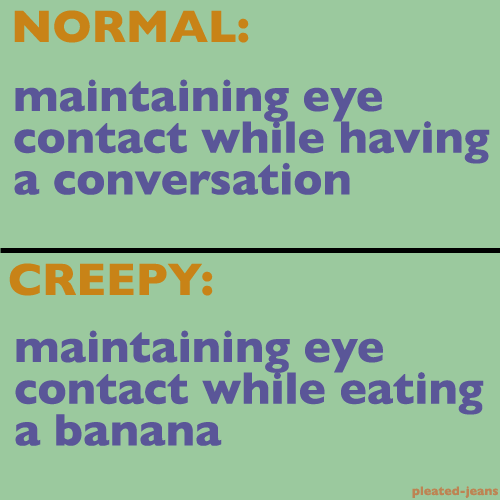
The Fine Line Between Standing Out & Being Creepy (Interview Series #5)
This post concludes my interview series. The previous posts in this series have provided tips that will help you stand out and beat your competition. For example, you can ask the interviewer insightful questions that no other candidates have asked or be able to think on your feet to answer tricky interview questions better than other interviewees.
You should definitely put your own spin on these tips so that they are a reflection of your true self. But keep in mind that there is a fine line between standing out and being creepy (or all out inappropriate for the situation).
For example, you could follow up after your interview by sending an astonishingly well written thank you email. Now you stand out. Or you could follow up by mailing each interviewer a handmade thank you card with the interviewer's face on the front of the card. Now you're creepy - now matter how well written your thank you note is.
Think before you act. Always make sure that your actions are appropriate for the situation. Always act professionally no matter how casual the interviewer seems.
What have you done in an interview situation that you thought would make you stand out but in hindsight you realize was creepy? When I was in my early 20's I once went in person, uninvited, to follow up on the status of my candidacy. Creepy!
Thursday, September 11, 2014
How to Be Ready to Answer Any Interview Question (Interview Series #4)
Sure, some companies might ask you oddball questions like "What three things would you bring with you if you were stranded on an island?". I never minded those questions. There's no wrong answer as long as you can explain your reasoning. I would bring a mechanical engineer, a zippo lighter full of lighter fluid, and drinking water.
The questions that always made me nervous are the typical questions such as "What is your biggest strength and your biggest weakness?" I always used to give the recommended answers: "My biggest strength is that I am both a strong individual contributor and team player. My biggest weakness is that I sometimes overcommit myself".
Years later I entered the world of Talent Acquisition and realized the error of my ways. Everyone else was giving those same answers. Everyone except the people who got hired. Those candidates had real answers. They also took the time to explain what steps they were taking to strengthen their weakness and maintain their strength. If you follow this formula, your answers to interview questions will likely change over time. Right now my answer is that my biggest strength is my ability to set priorities and manage them. To maintain this strength I read a lot about priority assessment methods, utilize the Eisenhower Matrix priority setting system, and use apps or software to make sure that I meet deadlines. My biggest weakness is that I interrupt people. I was raised in a family where this was the norm and this horrible habit was only pointed out to me recently. To improve this weakness I have joined Toastmasters. Contrary to popular belief, Toastmasters doesn't just help you with your public speaking skills - it also helps you improve your active listening skills.
In fact, joining Toastmasters is the best way to prepare yourself to be able to answer any interview question, even the tough ones. Instead of trying to memorize hundreds of interview questions and answers, you will learn how to prep, be a good audience for your interviewer, deliver your responses concisely and with confidence, and think on your feet.
Attend a few meetings as a guest. The worst case scenario is that you disagree with me. The best case scenario is that you join and learn to implement a slew of communication, listening, and evaluation skills that are lying dormant inside you, just waiting to be tapped into. I'm a member in District 31 - feel free to say "hi" when you visit!
Wednesday, September 10, 2014
How to End an Interview and Land the Job (Interview Series #3)
I like to go into interviews with an arsenal of questions. That way I'm guaranteed to have something to ask at the end. I try to pick 3-5 questions to ask, depending on how the conversation has gone. I print them out. There's no shame in not having them memorized. I have been collecting great questions to ask interviewers for the last decade or so and would like to share them with you in order of my most favorite to my least favorite.
- I'm even more excited now than I was when I applied. Is there anything that I've said, or haven't said, that makes you think I am not a great fit for the role? (Note: This question should be asked with confidence, not trepidation. This is always the last question that I ask in an interview. Always. To every interviewer. If there has been any miscommunication about what awesome talent you are, this is your chance to put that confusion to rest).
- What's one thing that's key to being successful in this company that somebody from outside the company wouldn't know?
- How would you describe the company culture, and if you could change one thing about the culture what would it be?
- Who are the heroes in this company and what characteristics do they have in common with one another?
- What are the characteristics of people you have hired in the past, but who've burned out, failed, or left?
- What is my future boss' leadership style?
- How has the job been performed in the past and what improvements would you like to see the new hire be able to implement?
- How is success measured in this role? What is the performance review policy and how do I make the most of it to ensure that I'm doing the best I can for the company?
- What are the group's best and worst working relationships with other groups in the company?
- What is the rhythm of work here? Is it consistent, or are there periods during the year where there are crunch times and we're pulling all-nighters?
- Which competitor are you most concerned about?
- How does this role help achieve the strategic goals of the company?
- What do you see ahead for the company in the next five years?
- What do you enjoy most about working here?
- What are the most attractive and least attractive parts of this job?
- What are the key accomplishments you'd like to see in this role over the next year?
What interview questions have you used that knocked an interviewer's socks off and made a lasting impression? Write them in the comments section!
Tuesday, September 9, 2014
The Power of Thanks (Interview Series #2)
It is immensely important to write a thank you note to your interviewers as soon as possible after each meeting. A thank you note can make you stand out among all the other candidates who did not write one. It also shows that you paid attention during your interview, care, and are committed to building a relationship with the interview team. However, writing the perfect thank you note can be challenging. Luckily, there are a few tips you can follow to get it right.
In your opening paragraph, be sure to thank the interviewer for taking the time to meet with you. This shows that you respect their time and understand that it is valuable. Express that you enjoyed the conversation and are excited about the opportunity to join the team.
If you are not a perfect fit for the role then you should address this in your next paragraph. Let the interviewer know that you recognize this but believe that you are up to the challenge and that your transferable skills make you well suited for the role.
Next, address the goals or culture of the company and talk about why you want to work there.
Lastly, thank the interviewers again for the opportunity. I personally suggest that you include a surprising hard sell to close your letter. For example, let the interview team know that you can be reached any time if they have additional questions or would like to offer you a second interview (although I would be a bad friend and coach if I didn't tell you that some people consider the hard sell a risky move).
Include a salutation such as "sincerely" or "kind regards" and following it with your name and contact information.
Tip: Avoid writing in a passive voice.
Need a customizable template to follow? Here you go!
Dear Interviewer's first name,
Thank you for meeting with me today to discuss the Position title position. I enjoyed our conversation and am excited about the opportunity to join the Company Name team.
I recognize that I do not have the traditional skillset experience that most of the other candidates have. However, I truly believe that I am up for the challenge. You mentioned that you need talent who is adjective 1, adjective 2, and adjective 3. My background in skillset 1 and skillset 2 is well suited for this.
I believe that the goals of Company name or department can be achieved and that fresh talent will expedite that process. I would be proud to work for a company that wants to company goal 1 and company goal 2. I look forward to becoming a part of that culture.
Again, thank you for considering me for this exciting opportunity. Please feel free to call me if you need additional information, have any questions, or would like to offer me a second interview! Thank you for your time, and I look forward to hearing from you soon.
Sincerely,
Your first and last name
Your phone number
Sunday, September 7, 2014
How to Make the Most of an Interview (Interview Series #1)
Do not use this time to judge the opportunity. Use this time to sell yourself. Focus on providing good answers to the interviewer's questions and asking good questions of them. Evaluate the opportunity a few hours after you have left and have had a chance to digest the experience.
If this were a slow dance, the interviewer should lead. Let the interviewer drive the process. Do things like ask if it is okay to take notes, or take a pause before answering a question to make sure that the interviewer has finished asking the question (and to give yourself a moment to think before you respond).
While you should not use this time to evaluate the opportunity, it is advisable to ask a handful of questions that will provide you with information for when you are later deciding if this is the right move for you. Ask good questions. If you do not ask any questions it may make the interviewer think that you don't care.
Most of your compatibility with the company and the role is determined by how you look and how you sound. Try to make your answers concise. Make sure that you are actually answering the interviewer's questions instead of going off on a tangent about something else. Dress appropriately for the interview. This may mean something different depending on your geographical location. For example, appropriate dress for East Cost interviews is usually business formal, while appropriate dress for West Coast interviews is often more casual. Ask you recruiter if you are uncertain of how formal the setting will be.
Enthusiasm may separate you from the rest of the talent pool. Some say that you are judged during the first two minutes of an interview, while others say that it is the first ten minutes. In either case, enthusiasm about the role and the company always makes for a good impression.
Last but not least, don't panic! Don't be so nervous that you are robotic. The interviewer wants to get to know you and to have a real conversation with you. Any interviewer who has been properly trained will sense if you are just telling them what you think they want to hear. Always be honest, but remember not to say anything
Yes, I intentionally left off any mention of having a strong handshake. A strong handshake will do you no good if you show up in a wrinkled shirt and spend your time talking over the interviewer. While it is a good way to start things off, a strong handshake is highly overrated.
Wednesday, September 3, 2014
Yes! You Should Include your Burning Man Volunteer Experience on your Resume!
A few weeks ago, after perusing many resumes and profiles of executive candidates, I sent a tweet out that read something like: You probably shouldn't include your Burning Man volunteer experience on your resume when applying to Corporate America.
That tweet has now mysteriously disappeared from my profile.
I've been mulling it over, and yes, you definitely should include your Burning Man volunteer experience on your resume. It indicates that you enjoy interacting with diverse groups of people and that you have the distinctive ability to stay sane when every one around you is acting like they're on drugs.
Lastly, if you volunteer at Burning Man every year, would you really want to work for a company that would view that as a bad thing?
So I suggest that you go ahead and start putting your unique experiences on your resume. After all, shouldn't your resume content be a reflection of you, instead of a reflection of who you think companies want you to be?
Monday, September 1, 2014
How to Change Careers and Find Happiness
“A tie is a noose, and inverted
though it is, it will hang a man nonetheless if he’s not careful.” This quote from Yann Martel, author of the
book Life of Pi, exemplifies why it is important to be happy in your career. If you wake up every morning loathing your
job or bored to death with your career track, it may be time to consider
changing careers.
The first step to making a
successful career change is to decide which new career will make you
happy. After all, starting over is
challenging, and you don’t want to have to do it more than once. Please, take the advice of someone who is
already on her third career! The most
important thing to consider when making this decision is: What are you
passionate about? After all, if you do
what makes you happy then you’ll never work a day in your life, right? Passion can come from many
different places, and will be unique to each individual.
The second step to making a
successful career change is to identify your transferable skills and
experiences. If you have tons of them
then that’s great – you will just need to adjust your resume to highlight these
transferable skills and experiences. If
you do not have many transferable skills, then you should educate yourself on
the industry and take classes that will help you develop the skills needed to
be successful in your new career. Be
sure to add this new education to your resume – even if it is ongoing. Also, make sure that your resume has industry
key words in it. Many companies use an
applicant tracking system that lets them enter in a keyword or Boolean phrase
and pulls all resumes that contain the search word or phrase. You should also be sure
to include a two to four sentence professional profile section at the top of
your resume that explains why you are super awesome and will add value to the
company.
The third step to changing careers
is to network and apply, apply, apply!
Have patience, and don’t get discouraged. When I was transitioning to a career in human
resources, I applied to over 20 job openings before I landed my first
interview, and to over 35 job openings before I got my first offer. I also suggest that you join networking
groups in the field you want to get into and attend their events. Even though you may be uncomfortable and feel
out of place, it will help you pick up industry jargon, and you may meet
someone who will give you a great job lead!
The fourth step is to
interview. You should go to every
interview you are offered, even if you think that the role or the company isn’t
perfect. It’s great practice for when you
finally get to interview for your dream job at your dream company.
Monday, August 25, 2014
How to Gain Visibility to Unadvertised Job Opportunities
![]() |
| Image credit |
Network, network, network!
Build a network of contacts in your area of expertise. Most major cities have a plethora of networking groups. Just do a LinkedIn or Google search to find out what is available in your area. Attend the live networking events to get people to know and trust you. By gaining their trust, they will be more likely to recommend you for an unlisted opening.
Participate in the social boards on LinkedIn. If you can use your expertise to help others solve a business problem then someone in that group may remember you if an appropriate opening comes along. Also, join and participate in appropriate forums. For example, if you are a female in the executive space then a women's leadership forum would be an excellent choice.
If you are interested in working for a particular company, find out who you know who works there, or who has someone in their network who works there and would be willing to make the connection for you. Don't be afraid to ask for a referral!
Increase your online presence and build your personal brand
Create a website or blog that highlights your expertise and why you are so uniquely awesome that any company would be better off with you on their team. Include the website on your LinkedIn profile.
Make sure your LinkedIn profile is complete and is full of keywords so that your profile will pull when recruiters search for people with your skills.
Take a course in search engine optimization (SEO) so that you will be listed in a higher ranking in search engine results.
Happy Hunting!
Have you been interviewed or hired for an unlisted job opening? How did you find out about the opportunity?
Sunday, August 24, 2014
5 Easy Steps to Create a "Professional" Headshot for your Social Media Profile
![]() |
| Robin Brodrick's LinkedIn Profile Photo |
Here's how we did it:
- Do it on the day you get your hair professionally cut and styled. If you are female, do your makeup (a matte finish works better than a dewy or sparkly one). I did my own makeup, but you could have your makeup done professionally at Clinique, Mac, or any other cosmetics counter in the mall. If you are male, make sure you are clean shaven or that your facial hair is neatly trimmed.
- Iron a neutral colored sheet and tack it to the wall. We chose gray because I thought it would compliment my skin tone, but you could just as easily use white, beige, or any other neutral color.
- Position one Bayco 150-Watt Incandescent Portable Work Light on either side of you. Using two lights like this helps reduce or eliminate shadows. To produce truer colors than a normal incandescent light, we used a bright white light bulb that produces a natural daylight appearance. You can use any brand, but we used Utilitech 18-Watt (75W) BR40 Medium Base Bright White Indoor Flood Light CFL Bulb Energy Star. The total cost for materials was around $32.
- Get another person to take a ton of photos of you from as many different angles as possible. When that person gets bored and starts complaining, you should review all of the photos, decide you don't like any of them, and get that person to take a whole other round of photos.
- Choose the photo you like best and crop it appropriately. I used Windows Live Photo Gallery, but you can use any program that achieves the same result.
See the difference that cropping makes?
You can also check out this awesome post by Ariella Coombs that outlines what your profile photo should not look like (although I disagree with #8 - I happen to love black and white profile photos).
Have you created your own professional looking profile photo? What methods did you use?
Saturday, August 23, 2014
How to Write an Effective Professional Profile for your Resume or LinkedIn Summary
Why do you need a professional profile?
Because many potential employers will not read your cover letter, so they may not know how absolutely awesome you are (note: this does not mean that you shouldn't include a cover letter in your application!). If you have a similar experience level as other applicants, your professional profile may help set you apart.
What is a professional profile?
A professional profile is a resume section that introduces who you are. It should include any notable professional, volunteer, or academic experience and accomplishments.
What isn't a professional profile?
A professional profile is not an objective statement. An objective statement states what the job seeker is looking for. A professional profile states what the job seeker can offer an employer.
Who should use a professional profile?
If you have experience in your field, or have transferable skills and experiences from another field, you should use a professional profile.
Who shouldn't use a professional profile?
Candidates who have never been employed, are applying for an internship, or have no transferable skills should not use a professional profile.
How long should a professional profile be?
Four sentences or less.
Template to write an effective professional profile
(Insert industry here) professional with extensive experience in (insert relevant skills here). Key accomplishments include (insert accomplishments here).
Example of a short professional profile
Human Resources Professional with extensive experience in talent acquisition operations. Key accomplishments include being recognized for outstanding contribution to TA Ops by EMC in 2014, developing and implementing a staffing plan for all BJ's new club openings on a national level in 2013, and growing GL Advisor's customer service department y 52% in two months in 2012.
Example of a long professional profile
Human Resources Professional with extensive knowledge in recruiting, talent acquisition operations, and working with senior executives across multiple business units and functions. Strong leader who understands that each human interaction is an inherently critical component of a broader strategy for continuous growth, which sets the stage for long-term success in creating higher profits, employee satisfaction, and customer loyalty. Key accomplishments include:
- Being recognized for outstanding contribution to TA Ops department by EMC in 2014
- Developing and implementing a staffing plan for all BJ's new club openings on a national level in 2013
- Growing Graduate Leverage's customer service department by 52% in two months in 2012
Do you use a professional profile on your resume? If so, do you structure it the same, or differently than I have recommended here?
Do you know someone who could benefit from including a professional profile on their resume? Why not share this post with them?
Have questions? Post them in the comments section and I will respond!
References
American InterContinental University's Career Services Department, 2014
Because many potential employers will not read your cover letter, so they may not know how absolutely awesome you are (note: this does not mean that you shouldn't include a cover letter in your application!). If you have a similar experience level as other applicants, your professional profile may help set you apart.
What is a professional profile?
A professional profile is a resume section that introduces who you are. It should include any notable professional, volunteer, or academic experience and accomplishments.
What isn't a professional profile?
A professional profile is not an objective statement. An objective statement states what the job seeker is looking for. A professional profile states what the job seeker can offer an employer.
Who should use a professional profile?
If you have experience in your field, or have transferable skills and experiences from another field, you should use a professional profile.
Who shouldn't use a professional profile?
Candidates who have never been employed, are applying for an internship, or have no transferable skills should not use a professional profile.
How long should a professional profile be?
Four sentences or less.
Template to write an effective professional profile
(Insert industry here) professional with extensive experience in (insert relevant skills here). Key accomplishments include (insert accomplishments here).
Example of a short professional profile
Human Resources Professional with extensive experience in talent acquisition operations. Key accomplishments include being recognized for outstanding contribution to TA Ops by EMC in 2014, developing and implementing a staffing plan for all BJ's new club openings on a national level in 2013, and growing GL Advisor's customer service department y 52% in two months in 2012.
Example of a long professional profile
Human Resources Professional with extensive knowledge in recruiting, talent acquisition operations, and working with senior executives across multiple business units and functions. Strong leader who understands that each human interaction is an inherently critical component of a broader strategy for continuous growth, which sets the stage for long-term success in creating higher profits, employee satisfaction, and customer loyalty. Key accomplishments include:
- Being recognized for outstanding contribution to TA Ops department by EMC in 2014
- Developing and implementing a staffing plan for all BJ's new club openings on a national level in 2013
- Growing Graduate Leverage's customer service department by 52% in two months in 2012
Do you use a professional profile on your resume? If so, do you structure it the same, or differently than I have recommended here?
Do you know someone who could benefit from including a professional profile on their resume? Why not share this post with them?
Have questions? Post them in the comments section and I will respond!
References
American InterContinental University's Career Services Department, 2014
Thursday, August 21, 2014
How to Optimize your Resume and Attract the Attention of Recruiters
Most
companies use applicant tracking systems that allow them to search their
database by keyword or by doing a Boolean search. Recruiters also use these
techniques to search for candidates on LinkedIn, CareerBuilder, Monster, and
other websites. It is critical that your resume be Search Engine Optimized
(SEO). There are 6 easy steps that you can follow to optimize your resume and
attract the attention of recruiters.
Keep the format simple
- Use Arial or Calibri for your font. These are the fonts that are recognized by most applicant tracking systems.
- Avoid using headers, footers, or text boxes.
- Use black font.
- Many recruiters will not read your cover letter (note: this does not mean that you should not include a cover letter!).
- This is your opportunity to succinctly tell recruiters why you are awesome, explain how you add value to the company, and mention some of your accomplishments.
- Keep it under 4 sentences.
- Place this section towards the top of your resume.
- For an example, check on the Summary section on my LinkedIn profile.
- Your resume will now be more likely to appear if recruiters are searching for a specific skill-set.
- List 10 skills or less.
- Organize your skills alphabetically or by category.
- Make this the last section on your resume.
- This will increase the odds of your resume appearing in recruiter searches.
- Mention all of your education, even if it is incomplete, ongoing, or not for credit.
- You would be surprised at how many strong candidates submit their resumes with no phone number or email address.
- Include your name, street address, preferred phone number, and email address.
- Some people don’t like to include their street address. It’s important to keep in mind that applicant tracking systems also let recruiters search by distance from the primary office location. If there is no street address on your resume then it will not show up in the search.
Do you know
someone who is searching for a job but isn’t getting any calls from recruiters?
Why not share this with them?
Image credit
Image credit
Subscribe to:
Posts (Atom)


.jpg)